Carabiners
Carabiners are used in hang gliding to attach the harness (that holds the pilot) to the hang glider. This connection needs to be detachable so the pilot can disconnect from the glider after landing safely and ideally, with the pilot able to do this with one hand. Most pilots fly with one carabiner and while this can be considered as a single point of failure, the carabiners used are incredibly strong! Steel carabiners are strongly recommended for hang gliding although some pilots may use a secondary aluminium carabiner as a back-up. I personally fly with a single steel carabiner specifically designed for hang gliding which I replace every 5 years. I prefer to fly with one carabiner as there have been occasions where I have top landed on a windy UK hill-top and need to disconnect from the glider quickly. Faffing around with two carabiners with one hand while trying to hold the glider down with the other is, well, tricky!
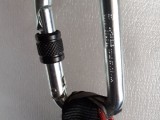
A carabiner's strength differs with its orientation and if it is open or closed. Typically, carabiners are strongest when orientated vertically with their gates closed, referred to as the major axis of the carabiner. This is the configuration to be used for hang gliding. Carabiners can also be loaded across their minor axis (horizontally), but this is weaker than the major. The maximum safe load of a carabiner across both axes is normally etched on the carabiner and is specified in kN. Needless to say, it’s important to load the carabiner across the major axis and ensure that the gate is securely closed.
Maintaining Load Across the Major Axis
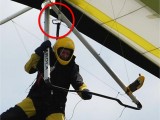
As we prepare to launch our gliders there is no tension in the hang straps and the carabiner is free to slip move around them. Sometimes, this can result in carabiners rotating with the hang-straps settling across the minor axis of the carabiner. When the hang straps tension, the carabiners may remain in this orientation. There is an infamous picture in my local hang-gliding club (see below) where this very situation happened and was photographed when the pilot came in to top land.
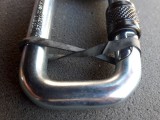
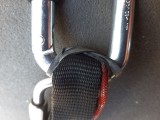
To avoid the carabiner rotating into this position, I’ve utilised a solution using off-cuts of an old bike innertube to form rubber bands which secure the hang-straps from the harness to the carabiner (see images below). I do change these rubber bands regularly as they will perish with time.